Showing posts with label Pam's Patter. Show all posts

Two thumbs up for Rush Creek

by Pam
Paul, Doug and I all sailed Sunfish at DinghyFest this past weekend. It was windy, wet and wild. Doug was 2nd, Paul 4th, and I was 6th. There were 16 boats registered.

In years gone by, I've been at this event and waited up to an hour between races. But not this year. They have been making a concentrated effort at training race committee and it showed. 

There were 4 fleets all on the same course. No rolling starts and the races started on time. Doug, doing his usual dawdling, made it to the start line of the first race with only 20 seconds to spare. As soon as a fleet finished they started them again. There were fleets starting on one side of the committee boat and at the same time fleets finishing on the other side. Not to mention that there were boats leaving the course randomly and boats tipping all over the place so it was a challenge to even keep track of everyone. And they did it in spades!

The MC Scows and Sunfish got in 6 races while the VX One's, buzzing past us left and right, got in 9 races. The Portsmith class with only two competitors, an 18 foot Aussie skiff and Paul Foerster with his kids on a JY only got in one race. The skiff never made it to the start line and they went ahead and started Paul F realizing that once the skiff went down on its way to the start line, that it wasn't racing. Paul F took the opportunity jump into the Sunfish fleet for a few races just to let us know who was king. Three races, three bullets.

Paul M, Doug and I all sailed every race even though it was quite windy. I actually had a 3rd in one race with neither Doug or Paul M even visible from the finish line. None of us tipped but Paul M did go swimming twice. I know I caused one of those when I did a crash tack and we collided and the other time I was right next to him but I'm not taking responsibility for that one. I think the hiking strap came undone.

It was a fun weekend. Going to different venues certainly stretches the experience level. I've never been in waves like that and I've never had a sustained gust hit during a run to where only the back half of the boat was touching the water. I had the main cleated most of the time going downwind and was two-handing the tiller feeling like I was somewhere between steering a gondola and riding a broom about the take flight repeating to my myself to stay under the sails.

At the end of the weekend, I was quite proud of myself for hanging in there for every race. Being a Balboa, I had the Rocky theme song playing in my head as I got back to the docks and felt like dancing around, fist pumping my hands in the air and singing 'Getting Stronger!" but in reality, I was only bent over with my hands on my knees and panting like a dog.

Read More...
AddThis Social Bookmark Button

Rowers! What's A Sailor To Do?

Race 1 on Saturday set the fleet on a collision course with three rowing teams heading up the lake. Paul and I watched helplessly from the committee boat as Bruce found himself smack in the middle of them with no escape options. Bruce called out that he was going to tack. Then there was lots of hollering on the center rowing shell that was closing in fast on Bruce …’heads up, Heads Up, HEADS UP … someone yell starboard, STARBOARD … STOP, STOP, STOP!’ … bam!

In reading several rowing sites, I discovered that the rowers probably didn’t yell ‘STOP’ since that only stops one crew member from rowing.  The proper term is “Weigh Enough, Hold Water” which is so foreign to me that even if they’d yelled it, I certainly didn’t hear it.

Doug was at the committee boat giving the Lasers a two minute head start and confidently said human power boats have right of way over sailboats but they shouldn’t have hit him.  Later, Bruce said quite confidently that sailboats have right of way. The team’s coach came over to the committee boat later and very politely apologized and said they were totally in the wrong. But were they?

Oh, by the way, Bruce was fine. He pulled out of the race until Doug caught up to him and reassured him that the big gaping hole he thought he had in his boat was maybe a scratch and then Bruce jumped back into the race. From the committee boat, the collision seemed more like a tap because when they dug their oars in, they looked like they stopped on a dime but drifted into Bruce. If they’d hit him with any speed, it could have been bad. Instead … learning opportunity.

So, I’ve scanned the US Coast Guard regulations, US Rowing Safety Guidelines and the International Regulations for Prevention of Collisions at Sea (“COLREGS”). USCG’s Rule 18 is a bit vague when it comes to rower/kayak/stand-up paddle boarder vs. sailboat. Various rowing sites have interpreted the USCG regs and have trained their rowers that a sailboat with wind must yield right of way but a sailboat without wind has right of way. Seems a bit subjective to me. What is the definition of a sailboat with wind? Bruce had wind but not enough to get him out of the way. Alas, an explanation of the COLREGS made it super simple:

General Responsibility - you’re not supposed to run into other people or things.

Tonnage - boats with more tonnage always have right of way even if they don’t.

Right of Way - man-powered beats sail beats motorboat beats seaplane. Human-powered boats (canoes and rowboats) have the right of way over sailboats.

BUT

Not Under Command - a vessel that is “not under command” has right of way. This refers to anchored or unoccupied vessels as well as those that have lost the ability to maneuver (e.g. through loss of power or their rudder [in irons]).

AND

Restricted Ability to Maneuver - boats with restricted maneuverability, whether due to fishing, draft, length, towing, or other causes, have right of way over vessels not so restricted.

Bottom line folks, as we start to see more and more kayakers, stand-up paddle boarders and rowers on the lake, in most cases, they have right of way and we must yield. I would argue that Bruce was unable to do so since the three rowers essentially had him pinned so he became the least maneuverable boat.

Had I been in that same situation, I would have defaulted to my foolproof emergency mode of: scream, let go of everything and throw my hands up in the air. Boat not under command … that trumps all.

As an aside, when I was on a judge boat during some match racing in Fort Worth, there was an instance where we had gotten in close (like we were supposed to) and the two sailboats were circling us. The judges stopped the boat, let go of the steering wheel and put their hands up and called ‘obstruction’ and immediately obtained right of way.  Works every time.


Contrary to what I've heard asserted, it is probably important to note that even though we might be racing, we do not have the authority to block off part of a public waterway and claim it as our race course. We must still follow the rules of the road even if someone wanders onto our race course.

Read More...
AddThis Social Bookmark Button

BUTTERFLY REPAIR - SHEAVE REPLACEMENT

by Pam
Lowes part #349199
At the top of the Butterfly mast is a sheave.  This is the roller thingy that you use to pull up the main halyard.  When it works, life is good but when it starts to get brittle and crack, the halyard gets stuck at all the exact wrong times and it's a real pain.  Perhaps being in Texas this is more of a problem because we sail year round and we also have the Texas sun.  Over the years, spare masts laying around the club have been stripped of their sheaves because finding the precise replacement part is a challenge.  The Butterfly parts diagram at Torresen Marine indicates the replacement part is a "mast head with sheave" and there is no price listed.  Sounds expensive to have to replace the mast head just to get a little sheave.

Well, thankfully, I have a house that inspires me to spend countless hours at Home Depot and Lowes walking the isles looking for all sorts of repair parts.  And what do you know, I found a Butterfly sheave.  While on the docks with Bruce this weekend for race duty ... yes, that would be without signing a liability waiver and without permission from WRBC's esteemed board who have decided that Doug and I should be banned from the club for life because ... oh, sorry, got carried away.

So, anyway Bruce was repairing an old mast that was missing a sheave and all the spare sheaves had been pilfered so I shared my find with him and he researched the details: 

Lowes carries a clothesline pulley that is 2 1/2 inches in diameter and a 1/2 inch wide.  This is identical to the Butterfly sheave and only costs $2.38 (Lowes' stock number 349199).  In order to put it in Bruce had to drill out the rivets on one side of the mast head fixture (but not both).  One side will slide out and then the sheave can be put in.  The 2 halves of the mast head are not attached together.  Presto, a smooth running halyard and a super affordable repair.  Thanks Bruce!!

Read More...
AddThis Social Bookmark Button

11-17-12 RACING

by Pam

Doug and I hadn’t been down to the lake since the Butterfly Nationals.  Although we didn’t sail, we picked a beautiful day to stop by for a visit.  It was like old home week at WRBC with Jackie, Lynn, Bowman, Gary, Bruce, Roger, Paul, Cathy and even a new recruit, Brittany, who Bruce had taken out for a sail.  Jackie had seen Tom and Dave recently and it was good to hear how they were doing.  I didn’t see who all sailed out of CSC except that Burton stopped by WRBC for a bit but it sounded like he’d been away for a while too.  It was really good to see everyone again.

In so many ways, it was like nothing had changed.  But it has.  Life happens.  People come and go, things happen and good health is not guaranteed to us.  As we talked with everyone and got caught up and I heard how everyone was doing, I was suddenly struck by the fact that everyone is getting older.  That was not something I’d felt with this group before. 

Every time we go sailing, we put on our preventative and protective sunscreen.  I’ve heard of people noticing a suspicious spot on their skin here or there and nipping it in the bud early but I haven’t heard of any threatening skin cancer lately.  Instead I’m hearing about other threatening conditions happening inside the body.  Perhaps, we’re fast approaching the time of realizing that we need to start taking preventive and protective measures inside the body too.  But, I have yet to hear a clear and simple formula that’s as easy and effective as ‘apply sunscreen every time you go outside.’ 

Lately, Doug and I have been inspired to take an experimental plunge into finding a simple formula.  We’re taking enzymes for digestion and repair, supplements for anti-aging, brain health, anti-cancer, and gagging down the green superfood supplements.  But most of that stuff is seriously nasty!  Add in all the healthy foods that are recommended and it’s enough to make me want to just throw in the towel and take my chances with a hamburger, french fries and a Coke.  But, we stumbled upon a darn good solution.  Here is a video of an infomercial for the Nutribullet.  I saw this and ran down to Target to buy one thinking if it didn’t live up to its claims, I’d just return it.  Doug tried it and after one drink we were both hooked.  Now it’s part of our daily routine and we feel like we’ve found our sunscreen for inside the body.  In fact, we’ve already figured out we’re going to have to buy a second one because Doug has all these regattas he's planning to attend where he'll be away for a week or so and neither of us is willing to do without.


Essentially, we’re just collecting lists of nasty tasting healthy stuff and tossing it into the mix and it all tastes like blueberries or strawberries or whatever fruit we use.  There is no other way I would ever eat alot of the stuff we’re mixing in. 

So, since Doug and I have volunteered to be guinea pigs, keep an eye on us and see if we start looking and acting younger and healthier.  And then join us.

Oh ... and I don't know what happened on the race course.  Cathy wasn't last.  Paul seemed pleased.  Bruce hit a bunch of stuff and Gary was rusty.  But they all sailed, they were all smiling and they all looked great.  Sailing heals too!

Read More...
AddThis Social Bookmark Button

Championship of Champions

by Pam
Beautiful Pewaukee, Wisconsin
As the results clearly show, Doug and Eddie didn't have the type of regatta they had hoped for.  In many ways, it turned out even better.  Not only did the guys have a good road trip and lots of fun at the event but Eddie really impressed the heck out of Doug.  He was the perfect crew.

Doug, in a moment of feeling rather uncompetitive, asked Liz Walker of U.S. Sailing when the event would be held in Lasers.  Her answer was a very emphatic, NEVER.  However, she indicated that they would LOVE to hold the event in Butterflys because they want classes where women can compete.  How awesome would that be?  The challenge is finding a host club that is willing to put forth the effort to host such an event which means coming up with 20 like new and fairly identical boats.  It is no small undertaking but the event has never been held in Butterflys and it may well be the one class that can truly determine the champion of champions because, not only can women compete equally, but skippers can be competitive in a Butterfly even if they have never sailed one (unlike what Doug and Eddie experienced with the C Scows).

Despite everything, Doug came home pretty jazzed.  He loved the experience.  He was wearing a hat cam and we sat down to watch some of the footage.  They'd get a good start and he'd think they were doing well and then they'd just get rolled and spit out the back.  Every race they tried something different and every race was a carbon copy of the one before.  I told him he should string the starts together, speed up the film and add some Roadrunner cartoon sound effects.  At one leeward mark rounding there was a guy right behind them who was getting frustrated with how slow they were going and he finally went to leeward of them and sailed through their wind shadow as if they weren't there.  Meep, Meep, yeeaaooww.

They didn't have boat speed and never did figure out how to make that boat go.  Doug, being the competitor that he is, actually kept thinking the next race was going to be the turnaround.  He went from a goal of winning, to a goal of top 3 ... 5 ... 10 ...15 and finally, please, please, please don't let us be last.  When they called it quits on Sunday, he was disappointed because he was just sure he was about to put all the pieces together.

Next year the event is in Lightnings.  Somehow, I think Doug is going to be doing some Lightning sailing this year.  Give him a ring if you're looking for crew.

Read More...
AddThis Social Bookmark Button

Shaun Hoffmann (7-3-1975 - 9-28-2012)

by Pam 
I’m in shock!  Shaun touched a lot of people’s lives, especially in the sailing community.  He will be missed.  He is the creator and original author of Fleet 20’s blog.  His enthusiasm and passion for sailing lead him to create many blogs and websites for various fleets and clubs, including White Rock Boat Club.  Most of the sites have since been modified but Shaun was the driving force behind them.  He felt the need to use the internet to build fleets and clubs and connect the sailing community all over Texas.  And from that drive, he actually ended up connecting people all over the world. 

Shaun sailed numerous boats.  He was like a kid in a candy store and couldn’t make up his mind.  He wanted to try them all.  And he did so with passion and gave his time freely.  Bits and pieces of Shaun are scattered across many fleet’s blogs and websites.  Pictures, videos, stories, boats bought and sold, as well as many new fleet and club members.  His presence is everywhere.

I knew Shaun primarily from sailing and the Fleet 20 blog.  One thing was clear, he was pure heart and passion.  He didn’t always encounter the best side of people, but he was such a gentle and forgiving soul.  I always had the impression that his ideal for the world was far too advanced in its simplicity and innocence.  He seemed to want everyone to get along, recognize people for both their contributions and faults and accept and appreciate each other regardless.  

His life was too short but he lived his life to the fullest and tried a little bit of everything and he was blessed in so many ways.  Our thoughts are with his family.  Please take the time to visit his Facebook memorial page: https://www.facebook.com/RipShaunHoffmann


Read More...
AddThis Social Bookmark Button

Butterflyers at the Championship of Champions

by Pam
C-Scow 101
Fleet 20's Doug and Eddie are now in Wisconsin getting ready to compete in the Championship of Champions.  The event is being held in C-Scows.  Neither have sailed one before but it's just a big Butterfly with a sail about three times the size of a Butterfly so how hard can it be, right?  The lake where the event is being held is almost identical to White Rock Lake except that it's alot cooler right now and it might actually be a little shiftier.  Should be a fun event.  They arrived last night and checked in this morning.  Today is the how to sail a C-Scow introduction and then the trial by fire practice race.  I can't wait to hear the stories.   

Read More...
AddThis Social Bookmark Button

FUN VIDEO

by Pam
Here is a link to a fun video from the 2011 Easter Laser Regatta. The video opens and closes with two of our favorite former Butterflyers and who also happen to be former Butterfly National Champions. Can you name those two sailors?

Read More...
AddThis Social Bookmark Button

NEW SPIN-OFF BLOG - IMPROPERCOURSE.COM

by Pam
Please note that the "Laser News" has been moved from this site.  A new spin-off blog has been created at www.impropercourse.com.  A tab as been added at the top of this blog for quick linking. 

This content of ImproperCourse will be more Laser-centric and cover the Laser District 15 circuit as well as the new developmental circuit (a/k/a North Texas Laser Circuit) that has been popular with the local White Rock fleet. 

Doug will be doing quite a bit of interesting Laser sailing this year and rather than trying to figure out how to make it relevant on the Fly site, a split (or expansion) seemed appropriate.  There will be links back and forth between the two sites so ImproperCourse will share content and Doug and I will continue to post to both.

The site is still under development so please let me know if you notice that something isn't working properly.

Read More...
AddThis Social Bookmark Button

MUSING 8

by Pam
I sent Doug to the lake to sail last weekend so that I could get some stuff done around the house without him under foot.  I thought I had a productive day but then Doug returned.  He was glowing, looked like he’d been on a two week vacation and was talking a mile a minute about everyone and everything.  I was jealous. 

Later Doug asked me why I hadn’t been sailing as much as usual and I absently mindedly blurted out because I hadn’t needed it.  And there it was.  Need.  As I contemplated that, I realized that I did indeed need it but had just forgotten.

See, I think if you’re a sailor that the water calls to you.  You go sailing and it somehow fills your needs whatever they are.  Sometimes, it’s thrilling or soothing and calming.  Other times, it’s frustrating and gets you motivated and moving or it’s frustrating and stops your in your tracks.  It seems that the water knows what you need and gives it to you every time.  Conflict, anger, drama, determination, motivation, adrenaline, exhaustion, frustration, community, peace, serenity, clarity, beauty, health, appreciation … it’s all there when you need it. 

Always, the mind and body come away engaged and healthier after some time on the water.  Now, Doug’s explanation will probably be some jibberish about negative ions and neurons lining up.  To each his own. 

Yep.  I want some of that excited, glowy, vacation look.  Hope that’s what’s on tap today.  Come get yours.

Read More...
AddThis Social Bookmark Button

T-BALL AND SAILING

by Pam
One out, runners on first and second. The batter waits with baited anticipation. The umpire places the ball on the tee; the pitcher makes a throwing motion, and the batter swings with all of his might. The ball flies between the shortstop and third baseman, hits the ground on the edge of the dirt and rolls into the outfield grass between two five year old outfielders who watch the ball pass by before realizing they need to give chase. The runners take off as the crowd yells with excitement. The runner from second scores with ease. The runner on first stops at second and smiles. His coaches and fans yell for him to run and he takes off for third. By this time, the two outfielders have fallen down, and begun wrestling for the ball. Finally, the left fielder comes up with the ball and heaves the ball toward the infield. The ball doesn't make it to the dirt and the shortstop runs to the ball. The batter has reached first and is headed for second. The runner who started on first, stops at third and smiles. By this point his coach is red-faced and about to pass out from a lack of oxygen as he "encourages" the five year old to head home. He takes off for home. The shortstop throws the ball toward home. The batter stops on second base and raises his hands to the sky in triumph. The ball hits the dirt and rolls right to the catcher at home plate. The runner heading home sees the ball, turns around and runs safely to third base. Time is called.  (read more)


I read this and laughed out loud.  On the face of it, this has nothing to do with sailing ... or does it?

How cool is Facebook?  I re-connected with my old friend, playmate and neighbor of 18 years.  When he was Speed Racer, I was Trixie and when he was Batman, I was Batgirl and on and on the adventures went for years and years.  Great memories!  Low and behold, I find that after all these years, we’ve both been blogging about sportsmanship.

These days he’s into the ball sports and I’m into the water sports but our observations are strikingly similar.  Reading his post made me realize that bad sportsmanship appears to actually be a simple loss of perspective.  Could it really be that basic?

Ben Ainslie, a three time Olympic Gold Medalist, recently exited his boat and boarded a media boat at the Finn World Championships in Perth, Australia to speak his mind about the boat’s interference in his race  (Ainslie disqualified; photos).  Ultimately, he forfeited a World Championship win that was easily his for the taking.  Perspective.  He was right but he was also wrong.  The media boat was doing its job (although, it could be argued, unsafely).  Is Ben a bad sport?  Doubtful.  He just lost his perspective for a brief moment.  It happens to us all.  So perhaps bad sportsmanship is a persistent loss of perspective. 

I am going to put watching five year old t-ball on my list of things to do next time I lose my perspective and need a little reality check on what’s really important.

Read More...
AddThis Social Bookmark Button

TIDBITS

Our new fleet captain, Brad, is taking his job seriously and has joined Shaun in the business of manufacturing future Butterflyers.  This model, arriving on Saturday, was a healthy, beautiful girl.  Congratulations!!  Keep 'em coming. 

For those who haven't found it, there is a very cool website, www.marinetraffic.com that is worth checking out.  Doug and I sat at home and could see what boats were currently going through the Panama Canal and which boats were piled up on either end waiting for their turn.  Doug noted that a freighter was about to enter Sydney harbor and then he logged on to the local web cam and within a few minutes was able to see the freighter enter the harbor.  Very cool site!

The ongoing downwind series will soon resume.

Read More...
AddThis Social Bookmark Button

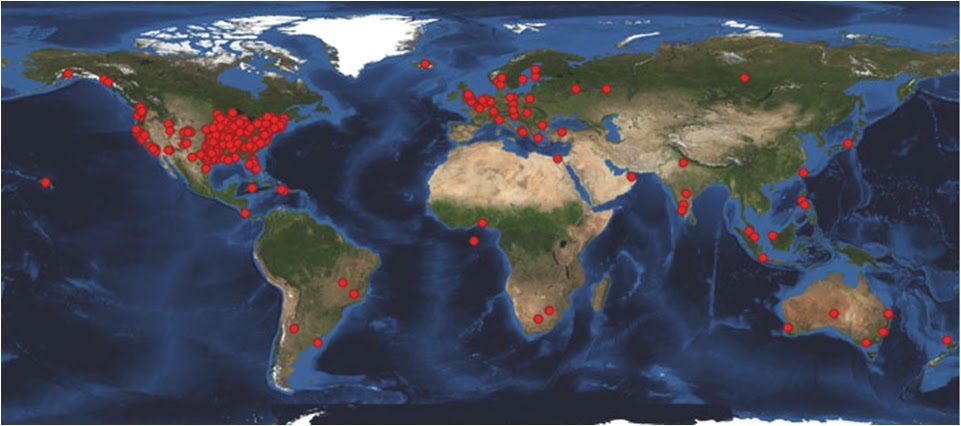
OUR INTERNET TRAFFIC

Our geographical stats counter was reset at the end of last year.  This is our internet traffic from the past year.

Read More...
AddThis Social Bookmark Button

BUTTERFLY SPORTSMANSHIP

by Pam


Days like this past Saturday make me so grateful to be a Butterflyer. Doug is constantly telling me that he loves sailing with the Butterflys and that the difference in the White Rock Lasers and Butterflys is night and day and the Fly competition is top notch.

I’ve sailed in many different fleets around the area and have noted that sailors of like temperament tend to flock together and the fleets themselves tend to take on a distinct personality and temperament. Go sit and watch a fleet start and round marks and you’ll instantly know the temperament of the fleet. Sadly, many ultra competitive fleets have excessive instances of bad sportsmanship in the form of intimidation, foul language, arguing over penalties, etc. and many of their minor infractions are no longer even recognizable as unsportsmanlike. It’s all very distasteful.

One of the most important things you can learn when sailing (and in life) is sportsmanship. When you encounter a good sport, you know it and when you don’t, you know that too. Interestingly, when you encounter someone who is still developing their sportsmanship personality and they flip flop from one to the other, you somehow know they aren’t a finished product yet and their reaction to incidents are often good predictors of which way they will ultimately develop. The choice of fleets they sail with can be good indicators as well.

The White Rock Butterfly fleet, however, is a bit of a paradox. The competition is such that a two time Laser world champion chooses to sail in this fleet and he isn’t always at the front and the same person doesn’t win race after race. And yet beginners feel completely welcome in this fleet. It is rare that you’ll ever hear any yelling or swearing on our course. And the Butterfly sportsmanship can really spoil you.

Doug was filming the races last Saturday and maintaining a running commentary. He was in first place with me and Bruce close behind. He looked back and saw me tack on top of Bruce. Bruce said ‘oh’ in a friendly way that also let me know he took note of the aggressive move on my part. I apologized saying I didn’t mean to do that. Doug’s commentary was, ‘Pam just tacked and made two mistakes. One she tacked right on top of Bruce which I’m sure was an accident and two she tacked into my dirty air’ then about 30 seconds later Doug tacked away to clear my air. Later in that same race Bruce was again behind me and we were on the last leg and I tacked on him again but before doing so said to him that this time it was intentional. Both Bruce and Doug sailed races that were competitive and respectful of others and both beat me across the line. I sailed my best and although I didn’t foul Bruce, I had an instance where I didn’t display the incredible Butterfly sportsmanship.

It speaks volumes about the Butterflys that the competition is so good and yet they try to sail cleanly and respectfully. Week after week and year after year, the Butterflys consistently offer up a silent invitation to a classier way of sailing that is both competitive and a display of a Butterfly sportsmanship that shows respect for everyone on the course and allows a sailor to enjoy the racing experience without the hassle of someone trying to sail ultra aggressively and ruin their race (at least not until the last leg).

After giving some thought to how the fleet has managed to cultivate this wonderful character I decided upon one primary reason. Our core group of Butterflyers have lived and sailed long enough that they’ve have learned to consistently remember … sailing is a gift … and they sail in a way that shows that they feel grateful for that gift and want to share it with others and the competition is secondary.

If we all remember this and apply it consistently, then hopefully we will inspire all who sail with us to sail with gratitude and maybe we will maintain our unique Butterfly sportsmanship for many years to come.

Read More...
AddThis Social Bookmark Button

BEGINNING SAILING (a female perspective)

by Pam

What to expect - When first starting to sail, you will likely start out a little overwhelmed and intimidated, then perhaps progress to being confused and sometimes embarrassed, then finally start to feel more comfortable but the intimidation probably won’t go away until you build confidence by tipping a few times and then jumping in and making a complete fool (or ass) of yourself as you learn the rules. Have no fear, the Butterfly fleet is the perfect place for you. There will always be someone there to come to your rescue or to pretend they didn’t see you do something really silly and forgive you and gently correct you when you barge right in and hit everything in sight. At some point or another, we’ve all done it too and you will be a welcome reminder of our own progress. When you find that you are out of control, the default is to scream and let go of everything and hang onto the boat. It’s a pretty effective recovery technique (unless you're driving the committee boat).

Personally, I’ve dropped the tiller and spun in circles more times than I can remember and I’ve made more mistakes in the rules than I can forget and I’ve been everything from elated to scared to frustrated and mad. All good stuff. Some best in hindsight though. The point being, if you sail with the Butterflys, you’re going to be part of a family so just jump in and get comfortable and do your worst (and best).

What to bring - In the summer - water, life jacket, whistle, gloves, water, sunscreen, sunglasses, hat, water, and a bite to eat at lunch and some more water. In the winter - life jacket, whistle, gloves, sunscreen, sunglasses, hat, water, a bite to eat, a light wind and waterproof layer as well as a comfortable warmth layer and a change of clothes.

Where to go - The Butterflys usually sail an Olympic (O) course, but you might see a Windward/Leeward (W) or a Triangle (T). Here are the basic diagrams of the courses. Many of your fellow sailors are over 40 and we often forget what someone just said or what we just saw on the course board and we have to ask for reminders all the time. So feel free to ask anyone out there anywhere along the course where you are supposed to go next. If you don’t get an answer don’t assume they are ignoring you. In all likelihood, they are very friendly and willing to help you but they just can’t hear you. You might have to use your whistle to get their attention.


What’s the goal - At some point you’ll ask yourself this question and it will often change. I’ve found that many women enjoy being on the water and they enjoying doing well in the fleet and feeling competitive but they don’t necessarily enjoy the competition when it comes to having to learn the rules, assert their rights and fight for their position. So do what’s comfortable. Put yourself in or out of the competition as you see fit. There is no reason you can’t start 30 seconds or a minute early and avoid the stress of the starts to begin with. The fleet will catch up to you and then you’ll have people around you that you can watch and copy. There is no reason you have to round every mark on the course. If you’re just beginning, it’s hard to learn when you’re at the back of the fleet all by yourself. So just go out and sail with the other boats even if that means starting early and skipping a few marks and turning and joining the fleet. Only start and round marks when you feel ready. Just be sure to tell the committee boat if you didn’t sail the entire course so they’ll know whether to score you.

Signals - There are many signals but to begin with just learn two flags and 4 times - Class flag, P flag and 5-4-1-go. The class flag is a white triangle with a red circle. The P flag is a blue flag with a white square. At five minutes before the go, there will be a sound and the White/Red flag will go up; at four minutes before the go, there will be a sound and the Blue/White flag will go up; at 1 minute before the go, there will be a long sound and the Blue/White flag will go down; then at the go, there will be a sound and the Red/White flag will go down.

Port/Starboard - Somehow this simple concept can be very difficult to remember when sailing. Visual reminders in the form of port/starboard cards taped to the deck wouldn’t be a bad idea.


Let’s go into detail with ways to remember it. Port tack is the easiest to remember and starboard is everything opposite. Port tack is when the wind is coming across the port/left side of the boat (looking forward) and the sail is on the right side of the boat. Port is a four letter word, left is a four letter word, port is a red wine and the color red is associated with port tack.

At night all boats and planes have red and green navigation lights. Red is on the left and green is on the right. Port, left, red. Port tack has to yield right of way to starboard so port/red is kind of like a stop light and starboard/green is like a go light. Learning port/starboard is fairly easy but when you meet another boat coming the opposite direction somehow the mirror image often causes confusion. When taking flying lessons, I learned a saying that they teach because at night if you see another plane all you might be able to see is their red and green lights and because you are traveling at high speeds it is important to quickly determine if you are on a collision course. Right-red-wrong. If a plane is coming at you and the red light is on the right, you are on a collision course. I use this saying when sailing except it’s right-sail-wrong. If a boat is coming at me and their sail is on my right (looking directly at them), then they are on starboard.

Rules - This is the most intimidating part. How are you supposed to keep them all straight when you’re having trouble even remembering what tack you’re on much less keeping track of someone else. To begin with, keep the rules super simple.

1) Starboard;
2) Leeward;
3) Clear Ahead;

These are the boats with right of way and you apply the rules in this order and go with the first one where there is a difference in the boats. You are not required to announce your presence or rights but may do so as a courtesy.

Starboard - If you are on starboard and another boat is on port, you have rights and you may alert them to your presence by calling out ‘starboard’.

Leeward - If you are both on starboard or both on port, move to the next rule, and if you are the leeward boat, you have rights. The wind direction is always determined by where the sail is. The side of the boat the sail is on is leeward. So the boat furthest from the wind (the side the sails are on) is leeward and that boat has rights. So if you are the leeward boat, the other person’s sail will be closer to you than the person and they might not be able to see you and you may alert them to your presence by calling ‘leeward boat’.

Clear Ahead - If both boats are on the same tack and neither is windward or leeward of each other but one is behind and the other ahead, you move to the next rule and if you are ahead you have rights.

Anytime your circumstances change (someone tacks, gybes, overtakes), go back to rule one and go with the first rule where there is a difference. It’s that simple, 1-2-3. So, if two boats are on port tack and one is ahead of the other, you’re on rule three but if the boat behind tacks to starboard, you go back to rule one and the starboard boat has rights.

For almost anything else someone will talk to you and ask for room or whatever else. Just keep in mind that at mark roundings, the inside boat is entitled to room if they ask.

Now, how to keep it straight. First, what tack are you on? Next, what tack is the other boat on? When they are going the same direction as you, it’s easy. When they are coming directly at you, remember one thing, if their sail is on the right side (as you are looking at them), they are starboard. Right-red-wrong - right-sail-wrong. It’s my personal danger, danger, danger signal.

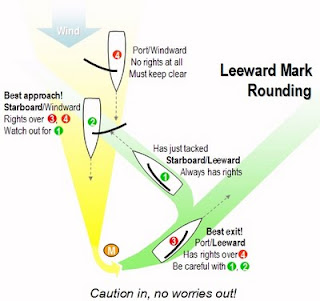
Let’s look at a few common scenarios for approaching and leaving marks because you can simplify things or complicate them depending on where you sail. Think logically about where you will most likely find yourself when you first start racing ... behind. Therefore, more often than not, you will be meeting boats at mark roundings that are going the opposite direction from you. So let’s look at the course in terms of where you want to place yourself versus where you don’t want to place yourself. The reason for this is because as you meet boats and figure out whether you have rights, they can change from port to starboard in a matter of seconds and completely confuse you so if you’re sailing in a complicated area on the course where they can turn the tables on you quickly, the rule of thumb will be don’t sail there or plan to have to yield right of way if you do.

Here is a basic diagram of what you might find as you approach the windward mark. As you can see it’s best to approach on starboard and leave on starboard.


Here is a basic diagram of what you might find as you approach the leeward mark. As you can see, you will need to yield to boats as you approach the mark and not worry about it as you leave.


How to Start - It is common to feel intimidated and hang back and not be on the start line. That’s ok but will put you well behind the fleet which isn’t much fun. Don’t feel like you’ll be in the way if you get closer to the line and mix with the other boats. You will, in fact, be in the way but just consider yourself a speed bump. The better sailors (read competitive) will see you and be proud of you for making the effort and can easily maneuver around you. There are alot of ways to determine the favored end of the line, the favored side of the course, etc. There are many different starting techniques. Many beginners tend to hang back and try to make a timed run at the line so they can steer a straight course and avoid right of way issues. That works fine. Another good approach is to do a couple of practice starts to get comfortable. Just do circles around the committee boat a few times. Watch out for the anchor line in front. As you hit the line in your circle, bring your sail in all the way and point as high as you can without stalling and then just look at the RC boat and the pin end of the line and pretend the gun just went off. Are you ahead of the pin end or behind it? If you’re ahead then the boat end is favored and if you’re behind then the pin end is favored. This means the fleet will generally bunch up on the favored end of the line. You might choose to start with them or away from them but this will give you a clue as to where they will end up with their last minute maneuverings.

Upwind - The two biggest factors on this part of the course is dirty air and when to tack. Beginners tend to follow and following often means sailing in dirty air. If you notice it, great, don’t do it. If you don’t, keep track of who you’re following and ask them later if you were sailing in their dirty air and if so, have them show you what they’d recommend. As for when to tack, there are lots of things to keep track of but even the better sailors are always learning better ways. Let’s just keep it simple. Sail the tack that takes you closest to the mark. You’ll have to imagine what the other tack will look like and then chose which is closer. Next, if there are boats around you, look at the angle of your boat compared to theirs. If they are sailing higher (bow pointing closer to the mark), then you are losing ground and need to tack. As you get closer to the mark, try to avoid sailing in complicated areas until you get more comfortable with the rules.

Reaching - Reaching is usually the best part of the course. It somehow feels like what sailing is supposed to feel like. Just enjoy the ride. If you find yourself gaining on someone (women usually do best here) just remember you usually have no rights when coming from behind and that the passing lane (on an Olympic course) is usually to the right (going high).

Downwind - This is the part of the course where you let the sail all the way out, lift the board a little and work on balance and looking behind you to see where the wind is building and seeing where your tell tales say the wind is. Just keep it simple and stay in control. If the boat feels unstable, put your board down and pull your sail in a little.

This should get you around the course with very little discomfort from the racing aspect and will allow you the luxury of getting comfortable with your boat handling. You’ll know when you’re ready to move to the next level and there will be lots of advice from your fellow Butterflyers once you get these basics down.

Read More...
AddThis Social Bookmark Button

MUSING 7

by Pam
I saw this on sale yesterday for $59.  A remote control electric winch with a 2000 pound capacity.
 
http://www.harborfreight.com/automotive-motorcycle/winches/2000-lb-capacity-remote-control-utility-winch-92860.html

I'm thinking if you take two 2 x 4 boards and plant them in the mud in front of and under the boat to make a ramp to guide it up to the docks and then mount this winch on a board that could be braced against something solid and mobile and hook it to the boat and press a button.  Heck, you might even be able to get away with just using a chair or ladder and just use your own weight to anchor it and then brace this winch across the open part of the chair or ladder and then press a button and watch the boat come to you.  Could it be that simple?

Harbor Freight is having a tool sale this weekend.  If this gets marked down again, I think I just might have to buy it.

Read More...
AddThis Social Bookmark Button

INNOVATION

by Pam
The U.S. Patent Office issued its 8 millionth patent on Tuesday.  Patent No. 8,000,000 was for a Visual Prosthesis Apparatus.  Now, seriously, if three inventors from California can manage to invent a way to make a blind man see, surely some of our ever so resourceful White Rock sailors can apply a little redneck ingenuity and come up with a way to get a Butterfly from the water onto the dock that isn’t dependent upon strength and fitness.  C’mon, rise to the challenge and leave your mark at the lake and make a few lightweights very happy (and independent). 

Read More...
AddThis Social Bookmark Button

WEDNESDAY NIGHT EXCITEMENT

by Pam

It happened again ... drama, drama, drama.  The evening  started off nice and quiet and just after sunset the lake was filled with the sound of sirens and the sight of flashing lights as the Fire Department responded to a call of a sailor in distress and launched their zodiac.  I must say, it was kind of cool to see the rescue team ... easy on the eyes.  Almost made me want to jump in the water and yell for help.

So, Doug and I were planning to do a little training on Wednesday evening.  A few people were planning to come but it’s sometimes difficult to get to the lake in the evening so it ended up being just me, Catherine, Amanda, Bruce and Doug.  Bruce and Doug set up observation/coaching chairs at the end of the docks and Amanda set some marks and we began some boat handling drills.  Catherine quickly decided she didn’t like the drills and announced that she was going to go sail by herself.  Now, what could go wrong there, right?

Doug did coaching and videoing with me and Amanda and we started out kind of out of control and got better as the evening progressed.  On one particularly crowded and bad rounding I believe I heard Doug say he was filming a “Girls Gone Wide” episode.  The evening was really lots of fun and very productive.  Then Bruce headed home and Doug jumped on my boat for a bit and I sat on the docks and watched.

All of a sudden, it sounded like someone started a motor.  It was the Laser sails flapping like crazy as the wind built and blew through.  Boats started tipping everywhere and surprisingly, many couldn’t get back up.  I think I counted about 5 within view and later heard there was a Flying Scot over further up the lake.  About 5 minutes later the sirens started and shortly thereafter a fire truck and another 3 vehicles with lights and sirens all began circling the lake.  They were going slowly and appeared to be searching along the shore and we couldn’t see Catherine anywhere.  The boats were leaving the course, the sun was setting and a CSC rescue boat was buzzing around to all the tipped Lasers. 

Doug and I both jumped on a Butterfly and headed for the boat I saw tip first that was still over.  As we got closer, we saw that it was Catherine.  She’d been over a good 20 minutes.  She was fine but she’d made enough noise that several people on shore had called 911.  For some inexplicable reason a CSC rescue boat didn’t get to her until a minute or two before the Fire Department and us (did I mention we were on a sailboat and Catherine was about a mile upwind?).  Catherine caught sight of us and started pointing to us.  Just like the Marines, the Butterflyers never leave their sailors behind.  Doug helped get her boat up and sailed it back.  When I returned to the docks there was an experienced sailor and WRBC member that had sailed by Catherine earlier with her screaming for them to go get the rescue boat and who was now trying desperately to launch the WRBC rescue boat.  No doubt about it ... the gas is safe and secure in the gas locker and only a handful of people can get it out.  It would have been entertaining if he’d gotten the gas and tried to pull away from the docks without knowing the combination to the chain securing the boat to the docks.  Somehow we have sacrificed safety for security.  Hopefully, the incident will spark some changes. 

All ended well, Catherine was driven back to WRBC by a Butterflyer and Doug and I chatted with the Fire Department who were concerned with their crude equipment and rescue procedures but Doug and I were impressed and grateful for them but a bit concerned with the rescue efforts of CSC and WRBC.  What a wonderfully safe time for a few things to go wrong and get our attention. 

Read More...
AddThis Social Bookmark Button

GOOD NEWS!

by Pam
Doug is home! The needs of the Laser Training Center in Cabarete are changing and evolving and Doug can continue his efforts from the US.  This works out perfectly because even though I talked to him everyday, I really wanted him back. On the docks a couple of weeks ago, Catherine said she wanted Doug back too.  We got our wish.  Yea!

Read More...
AddThis Social Bookmark Button

GOOD VS. GREAT SAILORS

by Pam
What makes a good sailor versus a great sailor?  Doug and I were pondering this question the other day in relation to what needs to be taught to make a sailor great versus good since Cabarete is all about training great sailors.  

It came down to a few questions?  Which is 'good' and which is 'great'?  Getting a perfect start every single race or getting a horrible start and being able to recover and come through the fleet and finish well?  Having perfect boat handling or tipping, doing penalty turns and not losing any places?  Picking the right side of the course every time or picking the wrong side and still finishing well?

I’d have to say that 'good' is perfect starts, flawless boat handling, and excellent tactics.  And I’d have to say that 'great' is making mistakes and having the experience and confidence to remain undeterred and to hang in there and consistently bubble to the top. 

Realistically, we’re human and we make mistakes.  How often can you expect to sail without making a mistake?  And how often have you made a couple of mistakes that ruined an entire race (if not the day)?

Doug’s resume says he’s a great sailor (or at least once was).  When I watch him sail locally though, there have been many times when I wondered if he’s just a washed up, has been, bonehead.  And then he’ll do something amazing that makes me realize he is indeed a great sailor.

The other day, the answers came to me.  'Good' and 'great' both require training.  'Good' is easier to learn because it feels good to learn it.  'Great' is harder to learn and doesn’t feel good at all.  Doug does ‘good’ training on his own and does ‘great’ training when sailing with others at anything that isn’t an international competition.

On a windy day, Doug would head to the lake to train.  He says he tacks, gybes, and rounds marks to exhaustion and then pushes himself just beyond that point.  Most importantly, he forces himself to gybe at a certain point and not necessarily in lulls.  I could sit at home and watch him on CSC’s harbor cam buzzing back and forth and then he would start tipping often and I was amazed at how long he’d continue to stay out after he’d started tipping.  That is his 'good' training.  He develops muscle memory to execute a tack or gybe under any and all conditions including complete exhaustion.  Personally, I’ve never really done this unless I’m with Doug and he’s coaching me. 

Any non-international sailing is 'great' training for Doug.  His preparation for events is sloppy.  Arriving late, forgetting equipment, sailing with damaged, improvised equipment or slow hulls.  His attention on the race course isn’t all that hot either.  Many things are second nature to him but I often get the feeling that he is intentionally dogging it.  Now, I’m right there with him at these events and all his sloppiness makes my stomach hurt and just about gives me a heart attack.  Doug, on the other hand, is unphased.  Takes it all in stride and most of the time he bubbles to the top and sometimes he takes himself out of the competition with his sloppiness.  It’s all part of his 'great' training.  He had to make a few adjustments when he realized it was becoming part of my 'quit sailing' training. 

The 'great' training has provided him with the confidence and experience to make quick on the water repairs and sail with compromised equipment, assess the start line and course from the shore or even the car on the way to the event, get a DFL start and look up and say this is going to be easy, do penalty turns without hesitation, and even take the time to stop and help others despite it slowing him down.  So many sailors don’t want to do penalty turns or get all bent out of shape over the smallest of things.  Doug takes it all in stride.  He’s competitive for sure but few races mean that much to him and he has learned to take setbacks with a grain of salt.  I’ve seen him refuse to do a penalty turn before and asked why later only to hear him say, ‘the guy was good and I wanted to stick with him but I didn’t sail through the finish line’.  Once again, I realize it’s all training to him.  I definitely don’t do any 'great' training. 

It’s easy to see that an international competition would quickly separate the good from the great.  Doug’s 'great' training provides him with a checklist of all the things that could go wrong and he diligently follows a checklist to make sure nothing is forgotten and nothing is left to chance and then when (not if) things go wrong, the experience and confidence kicks in and he knows he is prepared.

The interesting thing is that I like to compare sailing to life.  What makes a person good versus great?  I would probably say great people are defined by the way they handle adversity (and success).  So I suppose those great people have some experience and confidence when it comes to adversity.  I’ve watched Doug handle setbacks in his life with more patience than I could ever muster.  I only recently realized his eye is always on bigger things and that all those little setbacks are of no consequence to him.  I have much to learn from this great sailor (and man). 

Read More...
AddThis Social Bookmark Button